


I went to bed early. I did everything right. Lights out at a decent hour, phone down, a full night ahead of me. And when the alarm went off the next morning, I felt like I had been hit by a freight train. Heavy. Foggy. More tired than when I laid down. I remember lying there thinking, “How is this possible? I slept. Why do I feel worse?”
Have you ever done that? Given your body the sleep, the day off, the massage, the quiet weekend, and still woken up depleted?
For years I thought the answer was simply more. More sleep. More down time. More discipline about my routine. And I get it, I was there too. But here is what I eventually discovered, and it changed everything for me. When rest does not work, it is usually not because you need more of it. It is because you gave the wrong tired the wrong medicine.
You see, we treat tiredness like it is one thing. It is not. There are actually different kinds of tired, and each one is asking for something completely different. When we hand it the wrong solution, we can rest and rest and rest and still feel like we are running on empty. So let’s learn to tell them apart.
Physical tired is the one we actually understand. Heavy limbs, sore body, genuinely sleepy. This one wants exactly what you think … sleep, nourishing food, stillness. And here is the good news: this is usually the one we get right. Which is precisely why we get so confused when the same solution fails everywhere else.
Emotional tired is different. This is the freight train. This is going to bed early and waking up flattened anyway, because sleep was never the problem. Your body was not overworked, your heart was full. Emotional tired is not asking for stillness. It is asking for release. A good cry. An honest conversation. Someone to simply witness what you are carrying. And do you know what we do instead? We go lie down. We sit quietly. And fifteen minutes later we feel worse, because we handed our full heart more silence, and silence just gave all those feelings a stage.
Mental tired is the wired, scattered, can’t-settle kind. Your mind is buzzing with tabs left open. So we do the thing we have been told to do. We sit down to meditate. And our mind goes everywhere but here. We end up more unsettled than when we started, because a racing mind does not want to be caged and told to be still. Mental tired wants a change of channel. Movement. Fresh air. Nature. Something absorbing enough to give the mind a new place to land.
Soul tired is the quietest and the most overlooked. Nothing hurts exactly, but the color has drained out of things. You are going through the motions, checking the boxes, and feeling strangely flat. Soul tired is not asking for a nap. It is asking for meaning. Beauty. Connection. Something that genuinely lights you up. You could sleep for twelve hours and wake up just as empty, because the part of you that is tired lives somewhere a nap can’t reach.
Now here is where this becomes practical, because I am all about the practical.
Before you rest, don’t only ask, “How much time do I have?” Ask instead, “What kind of tired am I actually?” Am I physically depleted, or emotionally full? Is my mind racing, or is my spirit running on empty? That one question changes everything, because you finally stop reaching for the same tired solution and expecting a different result.
There is one more piece, and it is the one that catches so many of us. Sometimes the rest can’t land at all, because we never truly clocked off. Taking ten minutes on the couch while you know someone is waiting for you to start cleaning is not rest, it is resting with one eye open. The body cannot receive restoration while it is still standing guard. So give yourself full permission first. The ten minutes only work when you are actually in them.
Here is the reframe I want you to carry, the one I now live by:
I don’t need more rest. I need the right rest.
Your exhaustion is not a character flaw, and it is not a sign that something is wrong with you. It is information. It is your body and your heart and your mind telling you exactly what they need, if you will only slow down long enough to ask the right question. Match the rest to the tired, and watch how quickly your energy begins to return. Trust me, you’ll feel the difference.
If this made you pause, download the Midlife Energy Leaks Compass and begin discovering what your body has been trying to tell you all along.
Note: Articles are for general health information purposes only and are not intended to replace professional medical advice.
About Tina Haller:
 Tina Haller is a midlife health and longevity practitioner, speaker, and author who helps women understand the deeper shifts that occur when familiar strategies stop working. Her work focuses on decoding the physiological and nervous system changes of midlife—so women can relate to their bodies with clarity, steadiness, and precision rather than force.
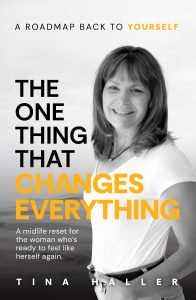
She is the author of The One Thing That Changes Everything: A Midlife Reset for the Woman Ready to Feel Like Herself Again and Feed Your Soul: Creating a Health Mindset, and is known for her grounded, insightful approach to helping women reconnect with their energy, clarity, and capacity in this stage of life.
To learn more about Tina visit: www.renewyoucoach.com.